Guatemala-Honduras-Mexico

Send us an enquiry
Send us an enquiry
Nom et prénom*
Adresse email*
Your message (then x in the "Je ne suis pas un robot"*
Save To Wish List

Adding item to wishlist requires an account

7126

Why choose Mayaexplor?

  • 30 years of experience
  • Local agency – no middleman prices
  • English speaking guides and drivers
  • Response in English within 24/48 hours

Feel free to contact us!

We specialize in tailor-made travel and will be happy to answer all your questions.

contact.mayaexplor@gmail.com

Fill out our travel request form

Duration : 17 days
Where ? Guatemala and southern Mexico (states of Chiapas, Campeche, Quintana Roo and Yucatán) with an incursion to Honduras to visit the archaeological site of Copán.
International flight (not included): arrival in Guatemala City
International flight (not included): departure from Cancún (Mexico)
General public
Customizable tour
A comprehensive circuit combining Guatemala, northern Honduras and southern Mexico to discover the region’s most beautiful places and the grandest archaeological sites of the Maya world, with the comfort of a customizable, optimized itinerary and private transfers.


The tour
  • A complete journey through Guatemala and southern Mexico, with a fascinating incursion into Honduras to visit the archaeological site of Copán
  • A rich itinerary exploring the region’s most remarkable UNESCO World Heritage sites — Antigua, Tikal, Palenque, Campeche, Uxmal, Chichén Itzá, and more
  • A stunning diversity of landscapes: volcanoes and highlands, tropical forests, and the Caribbean coast
  • The discovery of ancient Maya cities with the most magnificent stelae — Quiriguá and Copán
  • A boat excursion through the mangroves of the Río Dulce, in Guatemala’s Caribbean region steeped in stories of pirates

Immerse yourself in the mosaic of landscapes and cultures of the Maya world — this journey takes you from Guatemala to Mexico, with a stop in Honduras. The itinerary includes eight UNESCO World Heritage sites: the colonial city of Antigua, the Quiriguá site with its sculpted stelae and altars, the Maya site of Copán, the Tikal National Park, the ancient city and National Park of Palenque, the fortified historic city of Campeche, and the majestic pre-Hispanic sites of Uxmal and Chichén Itzá. You’ll also explore traditional Maya villages and markets of the Guatemalan highlands and Caribbean coast, as well as the charming colonial cities of Mérida and Valladolid, not to mention the turquoise waters of the cenotes and the beaches of the Yucatán.    

Possible extensions

  • Spend a few extra days relaxing on the Riviera Maya.
  • Visit the archaeological site of Yaxchilán on Day 10 (boat excursion on the Usumacinta River). (See all our extensions.)

(see all our extensions)

What our travelers say about this tour
  • Beyond the itinerary, which made for an excellent trip that fully met our expectations — traveling in great comfort while staying connected to local life — we especially appreciated the perfect organization: the drivers, guides, and boat pilots were all punctual and well-coordinated (something that would have been difficult to arrange on our own). Everyone was extremely helpful and flexible. Finally, we truly valued Thierry’s constant availability — he took time to answer all our questions before departure and stayed in touch throughout the trip.                        

    Xavier H.
    Group of friends
Itinerary overview
Day-by-day itinerary

Day 1Arrival in Guatemala (Saturday)

The itinerary may be adjusted to match your arrival day with the Chichicastenango market days (Thursdays and Sundays).

Accommodation: Hotel (Guatemala City)


Short transfer to the hotel upon arrival.
Overnight in the 10th district of the capital for a restful night.

Day 2Maya market of Chichicastenango

Meals included: Breakfast
Accommodation: Hotel (Panajachel – 1st night)   


Crossing fields and volcanic foothills, you’ll travel through the Guatemalan highlands to reach Chichicastenango, a town rich in tradition at 1,965 m (6,447 ft). One of the few pre-Columbian texts ever discovered, the Popol Vuh — often considered the “Maya Bible” — was found here. The town is best known for its vibrant, colorful markets and for the fascinating scenes of religious syncretism that unfold daily in and around its colonial church. Built by the Spanish in the 16th century atop an ancient Maya temple, the church’s staircase has 18 steps, one for each month of the Maya calendar.

As you wander through the narrow streets, you’ll experience one of the most famous handicraft markets in the region—a vibrant explosion of color and life. Vendors sell textiles, masks, incense, fruit, silverwork, and carved wooden figures. Among the most prized items are embroidered huipiles (women’s blouses) and traditional dancer masks.

Just a ten-minute walk from the center lies the town’s colorful cemetery, where you may witness Maya families performing ancestral ceremonies to honor their ancestors. Nearby, the Pascual Abaj hill serves as a sacred site for rituals that blend ancient Maya beliefs with Catholic elements.
In the afternoon, transfer to Panajachel, a peaceful village located at 1,500 m (4,920 ft) on the shores of Lake Atitlán.
Overnight in Panajachel.

Day 3Lake Atitlán: Maya villages of Santiago, San Antonio, and Santa Catarina

Meals included: Breakfast
Accommodation: Hotel (Panajachel – 2nd night)     


Lake Atitlán is considered one of the most beautiful lakes in the world, as writer Aldous Huxley once said. Set at 1 500 m (4 900 ft) in the tropical zone, it lies within an ancient caldera surrounded by three towering volcanoes of over 3 000 m (9 840 ft).

A boat journey across the lake, from north to south, takes you between these extinct volcanic giants to a tranquil bay where fishermen set out in their traditional wooden canoes at dawn. In Santiago Atitlán, you’ll discover women wearing richly embroidered traditional garments, each pattern reflecting local identity and heritage.    

 Return by boat to Panajachel, where your driver will meet you for a panoramic drive along the northeast shore. The route offers stunning views and photo stops as you visit on foot the picturesque Maya villages of San Antonio and Santa Catarina Palopó. From these villages, you’ll enjoy even more breathtaking perspectives over the lake and its three imposing volcanoes. In San Antonio, traditional male attire is still worn daily — a rarity in the highlands, where such garments are now usually reserved for women. The outfit consists of a red-patterned shirt and a handwoven wool wrap skirt in white and brown check. In these lakeside communities, the inhabitants dedicate themselves mainly to agriculture, traditional weaving, and the creation of remarkable hand-painted ceramics.

Return to Panajachel for a second overnight stay.

Day 4Lake Atitlán: market of Sololá and village of Concepción

Meals included: Breakfast
Accommodation: hotel (Antigua)


In the morning, stop at the Maya market of Sololá. The town’s geographic location—between the highlands and the Pacific coastal plain—explains the fascinating mix of people and the dazzling variety of multicolored traditional garments you’ll see here. Next, visit the authentic village of Concepción, where the inhabitants mainly cultivate onions and other vegetables on terraced hillsides. The village church is one of the rare colonial churches to have preserved its original 16th-century wooden roof structure through centuries of earthquakes. Continue across the highlands along the Pan-American Highway, one of the most scenic routes in the country.

Arrive in Antigua in the mid-afternoon and enjoy your first strolls through this welcoming town. The central plaza is lively and beautifully illuminated in the evening, highlighting the charm of its colonial façades.
Overnight stay in the historic center of Antigua.

Day 5Colonial city of Antigua

Meals included: Breakfast
Accommodation: Hotel (Guatemala City)


Nestled in a tropical valley between the Agua (3,760 m / 12,336 ft), Fuego (3,763 m / 12,345 ft), and Acatenango (3,976 m / 13,045 ft) volcanoes, Antigua is one of the most beautiful colonial cities in the Americas. A baroque jewel, it is listed both as a National Monument and as a Monument of the Americas, and is also a UNESCO World Heritage Site. Founded by the Spanish in the 16th century, the former capital suffered many earthquakes throughout its history — reminders of the living and dynamic nature that the ancient Maya once deified. In 1776, the Spanish government decided to relocate the capital to Guatemala City, leaving Antigua frozen in time. Since then, it has remained a city of elegant colonial architecture, romantic ruins, and lush gardens.     
The city is best explored on foot, as most of its landmarks are concentrated within the historic center: the Church of La Merced, the cathedral, the central plaza, the Capuchinas and Santa Clara convents, and Parque de la Unión.    

In the late afternoon, transfer to Guatemala City. Overnight stay in the 10th district, a comfortable and secure area of the capital.     

Day 6Copán archaeological site

Meals included: breakfast
Accomodation: Hotel (Copán)
Guided visit in English included: Copán archaeological site and museum


Travel to Honduras via the Atlantic Highway, crossing through a variety of landscapes—from the forested mountains of the Sierra de las Minas to the Motagua Valley and its cactus-studded plains and fruit plantations of melon and pineapple. After crossing the border (with the same vehicle and driver), visit the Copán archaeological site with a English-speaking specialist guide..  

The stelae of Copán are masterpieces of Maya art. The Hieroglyphic Stairway, carved with over 1,800 glyphs, is a marvel of craftsmanship and symbolism. Often referred to as the “Athens of the Maya world,” Copán is a UNESCO World Heritage Site. The on-site museum is also not to be missed — it brings together many of the site’s most remarkable reliefs, sculptures, and temple decorations. Set in a tropical valley at around 600 m (1,970 ft), Copán was rediscovered in the late 16th century, though serious excavations only began in the 19th century. The archaeological park remains covered by beautiful tropical forest, and as you explore, you may spot scarlet macaws—the national bird of Honduras—flying over the monumental plazas.          

After your visit, we recommend sampling the excellent local coffee.

Just steps from the village square, two small museums provide fascinating additional insights into the site’s history.

Overnight stay in the charming village of Copán Ruinas, known for its colonial-style architecture and welcoming atmosphere.

Day 7Archaeological site of Quirigua

Meals included: Breakfast
Accommodation: Hotel (Livingston)
Self-guided visit


Return to Guatemala and head toward the Caribbean! Along the way, you’ll pass through dry regions dotted with giant cacti and calabash trees. Stop at the archaeological site of Quiriguá for a self-guided visit. The site’s stelae are among the tallest ever discovered in the Maya world. Most of these extraordinary monoliths, altars, and carved calendars were produced during the 8th century by Quiriguá’s master artisans. Listed as a UNESCO World Heritage Site, the site lies within a pocket of tropical forest surrounded by vast banana plantations. The area is home to a wide variety of birds — toucans, parrots, and other colorful species — as well as impressive tropical trees. During the short drive through the banana plantation leading to the site, you’ll have the chance to observe the cultivation system of this giant grass — a crop that literally shaped Guatemala’s political, economic, and social landscape throughout the 20th century.

By midday, transfer to Puerto Barrios, the country’s former Atlantic port, where you’ll meet your boatman for the journey along the coast to the Caribbean village of Livingston. This isolated coastal community is home mainly to the Garifuna people — descendants of a 17th-century fusion between African slaves and indigenous Caribs. Their music, dance, language, and spiritual traditions were declared a Masterpiece of the Oral and Intangible Heritage of Humanity (UNESCO, 2001).
Overnight stay in the village of Livingston.

Day 8Boat trip up the Rio Dulce and visit to the San Felipe fortress

Meals included: Breakfast
Accommodation: Lodge (Tikal)


After breakfast, take a motorboat excursion along the calm waters of the Río Dulce, surrounded by lush tropical vegetation. With its impressive cliffs and dense jungle, the riverbanks are home to several protected natural areas: bird islands, mangroves, and secluded coves where pirates once hid to ambush Spanish ships loaded with treasures. The region teems with wildlife—monkeys, anteaters, toucans, coatis, iguanas, manatees, pelicans, egrets, and herons all inhabit this unique ecosystem. Midway through the journey, stop at the Maya village association of Ak’ Tenamit to learn about Kekchi Maya handicrafts and community-led conservation of the tropical forest. The Río Dulce, gateway to the Caribbean Sea, is Guatemala’s largest river, connecting the ocean to Lake Izabal, the country’s largest lake (590 km² / 228 sq mi).      2Together, the river and lake form a vital part of eastern Guatemala’s watershed, channeling rainwater from the Highlands to the Atlantic. At the end of the boat trip, make a stop at the small San Felipe fortress, which once protected Spanish warehouses on the shores of Lake Izabal from pirates and privateers. Today, this charming little fort is one of the postcard icons of the region.

In the afternoon, drive north through the Petén region. Along the road, you’ll see many ceiba (kapok) trees — Guatemala’s national tree and sacred to the Maya. The Petén, one of the last areas to be recolonized, was once one of the most densely populated centers of the ancient Maya world. Recent LIDAR studies have revealed that millions of Maya lived in these fragile lowlands for more than 18 centuries.     

Overnight in a lodge inside the national park, just steps from the archaeological site—an ideal location to soak up the magic of Tikal. At dawn and dusk, coatis, ocellated turkeys, and agoutis often wander near the lodges, making for easy wildlife observation.

It’s possible to return to the site for sunset or sunrise — contact us for more details.


Day 9Archaeological site and Tikal National Park

Meals included: Breakfast
Accommodation: Hotel (Flores)
Guided visit in English included: Archaeological site and Tikal National Park


Visit the archaeological site of Tikal with an English-speaking specialist guide. A UNESCO World Heritage Site, Tikal is one of the few places listed for both its natural and cultural value — recognized for its extraordinary biodiversity and its immense archaeological importance. This former ceremonial center, active mainly from the 9th century BC to the 10th century AD, is located in the heart of the tropical forest. With its majestic pyramids (Temple IV rises more than 70 m / 230 ft high!), Tikal is considered the most impressive Maya site in the country — and perhaps in the entire Maya world. During your visit, your guide will also help you discover the rich flora and fauna of the park. The protected ecosystems are home to several species of monkeys, anteaters, coatis, deer, and more than 300 species of birds. The tropical vegetation is equally remarkable, with over 200 species of trees recorded within the reserve.            2  
In the mid-afternoon, drive back to Flores, a charming small island town on Lake Petén Itzá, famous for its beautiful sunsets.

Overnight stay in Flores.

Day 10 Border crossing into Mexico and visit of Bonampak archaeological site

Meals included: Breakfast
Accommodation: Hotel (Palenque)
Self-guided visit


Transfer by vehicle to Bethel and the Usumacinta River, which marks the border between Guatemala and Mexico. Cross the river by motorboat to the small hamlet of Corozal, on the Mexican side, surrounded by lush tropical forest. Meet your Mexican driver upon arrival. Continue on to the Bonampak archaeological site, located deep in the Lacandon Forest. Both the national park and the site are partly managed by the Lacandon Maya, one of the few Indigenous groups in Mexico to have preserved many pre-Hispanic cultural traditions. The Lacandon still wear their traditional long white tunics, and men keep their hair long. The French ethnologist Jacques Soustelle wrote fascinating accounts of this community in his book Les Quatre Soleils.
You’ll travel into the jungle in a vehicle operated by the Lacandon community association, arriving at the Bonampak site, famous for its remarkably well-preserved murals. These stunning 9th-century frescoes, painted with striking realism, cover the walls of three small chambers. They depict richly dressed priests and nobles attending a ceremony in which a child becomes the heir of a noble family; a musical ensemble playing wooden trumpets, drums, and other instruments; a vivid battle scene showing the capture of prisoners; and those same captives later seated before the lord of Bonampak, magnificently adorned. Another mural portrays an elaborate ritual dance in which participants wear refined costumes and masks representing gods, while the lord and his family perform bloodletting rites by piercing their tongues with needles — a powerful expression of the pre-Columbian Maya belief that self-sacrifice was essential to the balance of the world.
Continue by road to Palenque.

Overnight stay near the village of Palenque, only a few minutes from the ancient Maya city and its impressive forest surroundings.

Day 11 Archaeological site of Palenque and fortified city of Campeche

Meals included: Breakfast
Accommodation: Hotel (Campeche)
Included: Guided visit in English – Palenque archaeological site


The archaeological site of Palenque lies deep within lush tropical forest. A well-maintained trail allows visitors to observe both flora and fauna as they explore. Although smaller than Tikal, Palenque stands out for the elegance of its architecture and the refinement of its carvings and stuccoes. The excavated area covers about 2.5 km² (1 sq. mi.), which represents only about 10% of the city’s full extent — over a thousand additional structures remain buried under the forest canopy. These mysterious mounds allow you to imagine how the city must have looked when rediscovered in the late 18th century. A UNESCO World Heritage Site since 1987, Palenque is celebrated for its architectural harmony and the richness of its bas-reliefs and sculptures. Among the most remarkable structures are the Temple of the Inscriptions, the Palace (one of the finest architectural achievements of the Classic Maya period), the Temple of the Cross, the Temple of the Foliated Cross, the Temple of the Sun, and the ball court. During your guided visit with a specialist, you’ll also admire numerous carved stelae. Time permitting, you may visit the excellent site museum, which showcases many artifacts from the excavations.

In the afternoon, drive to the colonial city of Campeche. In the historic center, you’ll feel transported to a Spanish colonial port of the New World. The city’s walls and fortifications, remarkably well preserved, once protected the harbor from pirate and corsair attacks coming from the Caribbean Sea.

 Overnight stay in the historic center of Campeche.

Day 12Uxmal archaeological site and the city of Mérida

Meals included: Breakfast
Accommodation: Hotel (Mérida – 1st night)   
Guided visit in English included: Uxmal archaeological site


Suggestion: Take an early morning stroll around Campeche’s main square. The soft morning light enhances the pastel tones of the colonial houses — Campeche is undoubtedly the most colorful city in the Yucatán Peninsula!

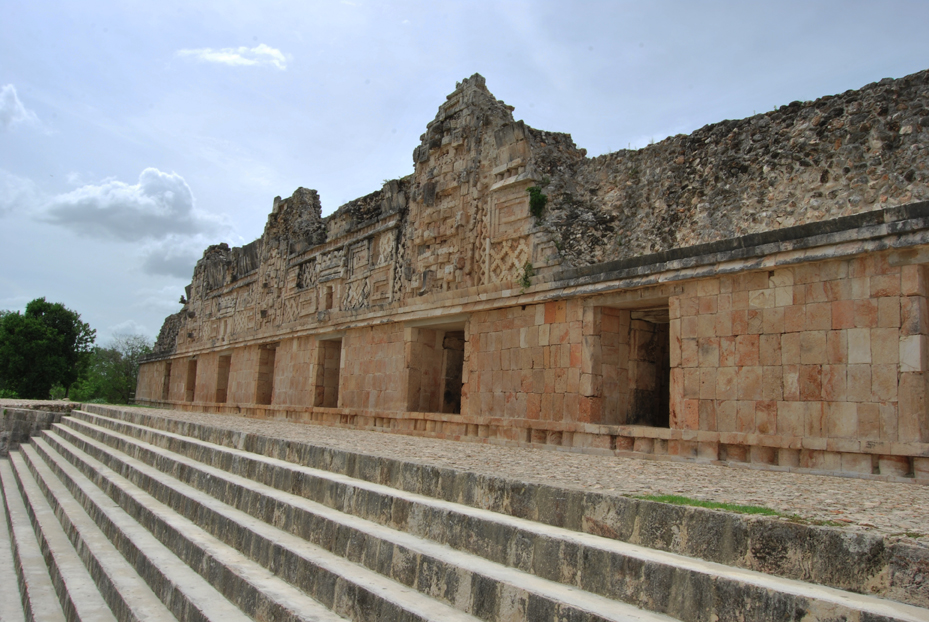
After breakfast, depart for the archaeological site of Uxmal. Visit with an English-speaking specialist guide. Maya architecture here rivals that of Palenque in elegance and beauty, with the distinctive Puuc style — a kind of “Maya baroque” characterized by exuberant sculpted decoration covering the façades. Uxmal is one of the few Maya ceremonial centers where visitors can appreciate the layout of the city almost in its entirety, in an exceptional state of preservation. The most important structures include the Pyramid of the Magician, the Nunnery Quadrangle, the Governor’s Palace, the House of the Turtles, and of course, the ball court. Founded around 700 AD, the city once had a population of about 25,000. The temples of Uxmal and those of neighboring cities represent the pinnacle of late Maya art and architecture. Many buildings are adorned with stylized masks of Chaac, the rain god. The abundance of carved motifs expresses the complex Maya cosmology and their deep spiritual connection to the natural world.

After the visit, drive to Mérida, located 62 km (38 mi) north of Uxmal. Known today as the White City, Mérida was founded in 1542 on the site of an ancient Maya settlement and is now the capital of the Yucatán. It is often considered one of the oldest continuously inhabited cities in the Americas.    

Overnight stay in the colonial center of Mérida.

Day 13Colonial city of Mérida

Meals included: Breakfast
Accommodation: Hotel (Mérida, 2nd night)     


Enjoy a free day to explore Mérida’s colonial center. In the morning, stroll through the old town’s narrow streets, markets, and shaded plazas. Mérida is one of Mexico’s most vibrant cities. Like most Spanish colonial cities in the New World, it was built on a perfect grid of straight streets and square blocks.
The Municipal Palace of Mérida stands on the site of a former Maya pyramid, whose stones were used to build both the cathedral and the Casa Montejo (not to be missed). The colonial area is organized around a series of charming squares, each dominated by an elegant church. Mérida prospered until the early 20th century thanks to henequen (sisal) production, which brought great wealth to the region — still visible today in the city’s grand and ornate mansions. Until the mid-19th century, Mérida was a fortified city, and several of its impressive gates have survived to this day. Suggestion: Visit the Gran Museo del Mundo Maya, which features outstanding ethnological and archaeological exhibitions.

Optional excursion available to visit the Kankirixché cenote, located near Mérida. Contact us for details.

Second night in Mérida’s historic center.


Day 14Archaeological site of Chichén Itzá

Meals included: Breakfast
Accommodation: Hotel (Valladolid)
Guided visit in English included: Chichén Itzá archaeological site


Drive across the Yucatán Peninsula to visit the world-famous archaeological site of Chichén Itzá.
With your English-speaking specialist guide, explore this immense city covering over 300 hectares (740 acres) — once one of the largest Maya centers in the region.
Chichén Itzá’s monuments influenced the entire Maya world from the 10th to the 15th century. The sacred city is dominated by the Pyramid of Kukulkán (the Feathered Serpent). You’ll also discover the Temple of the Warriors, the Cenote of Sacrifices, the Wall of Skulls, and the ball court. The city’s history spans nearly a thousand years, during which several cultures succeeded one another, leaving their architectural mark. The site’s unique blend of styles — such as the Maya Classic architecture of the El Caracol Observatory and the Toltec influence in the Pyramid of Kukulkán — adds to its fascination.
Chichén Itzá was probably the main religious center of the region during the 10th century. It was designated a UNESCO World Heritage Site in 1988 and voted one of the New Seven Wonders of the World in 2007. Without a doubt, it is one of the most remarkable sites in the Maya world. The city was built near two natural sinkholes (cenotes) that provided access to underground water — a precious resource in this karstic region. The last major monuments were built around the 13th century, and the ruins were rediscovered in 1841. Even today, Chichén Itzá continues to reveal its mysteries.

Drive to Valladolid, a delightful small colonial town.
Overnight in Valladolid.


Day 15Archaeological sites of Ek Balam and Cobá

Meals included: Breakfast
Accommodation: Hotel (Tulum – 1st night)**  nuit à Tulum).
Included: Guided visit in English – Ek Balam archaeological site


Head toward the Caribbean coast, stopping to visit two remarkable archaeological sites that remain off the usual tourist trail.

North of Valladolid, discover the small but superb site of Ek Balam (about 30 minutes away), where remarkably well-preserved high-reliefs and sculptures have been uncovered. Guided visit in English. Ek Balam is one of the Yucatán Peninsula’s lesser-known treasures and should not be missed. You can also take a refreshing swim in the nearby cenote.

Continue to the site of Cobá, surrounded by a series of lakes. After Chichén Itzá, it was one of the region’s major pre-Columbian cities. Cobá once covered more than 70 km² (27 sq mi) and developed an extensive network of paved roads (sacbeob). You can explore them at your own pace by renting a bicycle. Inhabited from the 1st century BCE until the arrival of the Spanish conquistadors, Cobá likely controlled trade routes and exerted strong regional influence.2     

Overnight in Tulum village. (Two nights in total at this location.)

Day 16Archaeological site and beach of Tulum, Ka’a Lum Lagoon

Meals included: Breakfast
Accommodation: Hotel (Tulum – 2nd night)    nuit à Tulum).


A day to enjoy the Caribbean!

Explore on your own the small but stunning archaeological site of Tulum, a walled Maya city overlooking a spectacular white-sand beach and turquoise waters. Inhabited mainly by merchants closely linked to the powerful city of Cobá, Tulum is believed to have been founded around 564 CE, though most of its structures date after 1200. At that time, coastal trade was thriving, with boats sailing as far as Costa Rica and Panama. The city was protected by an outer wall over 6 m (20 ft) thick and 4 m (13 ft) high, as well as an inner enclosure. The Castillo (the “castle”) is the site’s most impressive building, but you’ll also see the Temple of the Descending God, the Main Causeway, and the Temple of the Frescoes.     

Afterward, enjoy a swim at Ka’a Lum Lagoon (15 minutes from Tulum), a hidden gem of the Riviera Maya surrounded by tropical forest. Its turquoise waters conceal a deep cenote at the center — a peaceful alternative to the crowded beaches of Tulum.   Second overnight stay in Tulum.

Day 17Return flight

Meals included: Breakfast


Transfer to Cancún airport for your return flight.

The budget

Cost in US$, per person, based on double occupancy and number of participants:

2 people
3 people
4 people
4812
3795
3345

5 people
6 people
7 people
2995
2676
2738

Single room supplement
Triple room discount
680
185

For full details of services, please contact us

Don’t hesitate to ask for customized programs and itineraries tailored to your wishes and constraints — we specialize in personalized travel throughout Guatemala and across the entire Maya world!

Price includes:

  • 16 nights in 2–3* hotels, double room, with American breakfast ;
  • All ground transfers and transportation in private vehicle with driver (Days 1–10 in Guatemala with English-speaking driver*) ;
  • Private boat transfers: from Panajachel to Santiago (Day 3) ;
  • from Puerto Barrios to Lívingston (Day 7); from Lívingston to Río Dulce (Day 8) ;
  • and from Bethel to Corozal (Day 10) ;
  • Entrance fees to Copán (Day 6) and Tikal (Day 9) ;
  • Entrance fees to archaeological sites in Mexico: Bonampak, Palenque, Uxmal, Chichén Itzá, Ek Balam, Cobá, and Tulum ;
  • Guided visits with specialist guides (English-speaking*) at Copán, Tikal, Palenque, Uxmal, Chichén Itzá, and Ek Balam.

* English-speaking staff subject to availability at the time of booking.

Price does not include:

  • International flights ;
  • Guide services other than those specified in the program ;
  • Airport taxes ;
  • Travel insurance (cancellation/interruption, baggage loss, assistance) ;
  • Hotel surcharges during Christmas/New Year holidays and Easter week ;
  • Entrance fees to sites, museums, and reserves not listed under “Price includes” ;
  • Anything not specifically mentioned in “Price includes”.

Expenses on site:

  • Meals not listed above ;
  • Drinks and personal purchases ;
  • Tips ;
  • Entrance fees not listed under “Price includes” ;
  • Border fees when entering Honduras (a few US dollars, payable directly; quick and simple procedure according to Central American regulations) ;
  • Mexican tourism tax: approximately US$25, payable in pesos during your stay at a local bank.

Price adjustment:

Published prices apply outside the Christmas/New Year and Easter periods (hotel prices may increase during these times).

Payment schedule:

More than 35 days before departure: a 40% deposit is required at the time of booking. For bookings made less than 35 days before departure: full payment is required upon booking. The balance of the total trip cost must be paid no later than 35 days before departure.

On the Ground
Organization

Our Team :

  • Our trusted drivers (English-speaking during the first 10 days in Guatemala, subject to availability at the time of booking) ;
  • Experienced boatmen we’ve worked with for many years ;
  • Carefully selected guides for their field expertise and professionalism (experience, reliability, group management, and language skills) ;
  • Our office team, available for any questions or assistance during your trip.

Transportation :

  • Private ground transfers in air-conditioned vehicles ;
  • rivate boat transfers: on Lake Atitlán (Day 3), along Guatemala’s Caribbean coast (Days 7 and 8), and across the Usumacinta River (Day 10).

Accommodation :

2–3* hotels in double rooms.

Triple rooms are available upon request.

Regardless of category, all accommodations are selected for their charm, comfort, and excellent location.

We encourage you to review the hotel selection we’ll send you — visiting the hotel websites will help you understand our choices and confirm the quality of accommodations. In terms of value, comfort, location, and character, they’re widely regarded as among the best in the country.

Please note: there is no official hotel star rating system in Guatemala. The number of stars indicated reflects a combination of our own evaluations, traveler feedback, and commonly accepted local standards.

Meals :

  • Breakfasts at the hotel ;
  • Lunch with a local Maya family in San Juan La Laguna (Lake Atitlán) on Day 4.

Money & currency :

In Guatemala
The local currency is the Guatemalan quetzal (GTQ).

Exchange rate (indicative): 1 US$ = 7.60 GTQ.

The US dollar is widely accepted throughout the country and is considered the reference currency. Euro exchange is very difficult. Small purchases are usually made in local currency. Visa credit cards are well accepted; MasterCard can sometimes be more complicated to use. ATMs are available in major cities, near banks, and in many gas stations and shopping centers.

In Honduras
The local currency is the Honduran lempira (HNL).

Exchange rate (indicative): 1 US$ = 25 HNL.

ATMs are widely available throughout the country.

However, in Copán, located just 10 km from the Guatemalan border, payments are generally accepted in Guatemalan quetzals for meals, drinks, and souvenirs, and in US dollars for entrance fees and museums. Using Honduran currency is therefore unnecessary.

In Mexico
The local currency is the Mexican peso (MXN).

Indicative exchange rate: US$1 = 20 MXN.

This is the only currency accepted in shops and restaurants (U.S. dollars and euros are rarely accepted). ATMs are available in most towns and cities.

Note: the Mexican peso is symbolized by a single-barred “$”. Don’t confuse it with the U.S. dollar.

Photos